

Quick Guide to Understanding Capital Gains Tax

Capital gains taxes are all over the news in recent days, but not all capital gains are taxed equally. To better understand capital gains tax, it is essential to consider the variables. If you have been following our recent blog postings, you may have noticed we have focused on providing clarity on Meme Stocks & the US Inflation Rate. As part of our Personal Financial Planning 101 series, this article will cover understanding capital gains tax.
What Are Capital Gains Taxes?
It is important to consider the tax implications when analyzing an investment’s performance since it can drastically affect the amount of profit the investor will receive. These tax repercussions are referred to as capital gains.
When a stock is bought for $100 and sold for $150, there is a $50 gain that will be taxed. This gain is “unrealized” while the stock is owned and does not become a taxable “realized” gain until the investment is sold. Even if the funds are not withdrawn from the account, taxes are still owed on any gains that are “realized” within the account.
Short-Term Vs. Long-Term Capital Gains Tax
If the stock was held for less than one year then the gains will be considered short-term. This means that the gains will be taxed as ordinary income when you file taxes. The $50 gain in the example above would be subject to whatever tax bracket you fall into.
This means it can be taxed up to a maximum of 37% in 2021! If the stock is held for more than one year, the gain is considered long-term and will be taxed at a preferential rate. The maximum long-term capital gains rate is 20% for high-income individuals/couples.
See below from Nerd Wallet for an overview of these preferential tax rates.
Calculating Your Capital Gains
When you file your taxes, you only report the net gain or loss for the year. If you make $50 on one stock but lose $100 on another, you have a net $50 loss. This loss will directly reduce your taxable income. However, only $3,000 worth of losses can be deducted in a single year. Any losses above $3,000 will be carried forward and can be applied to next year’s tax returns.
!Capital Gains Taxation
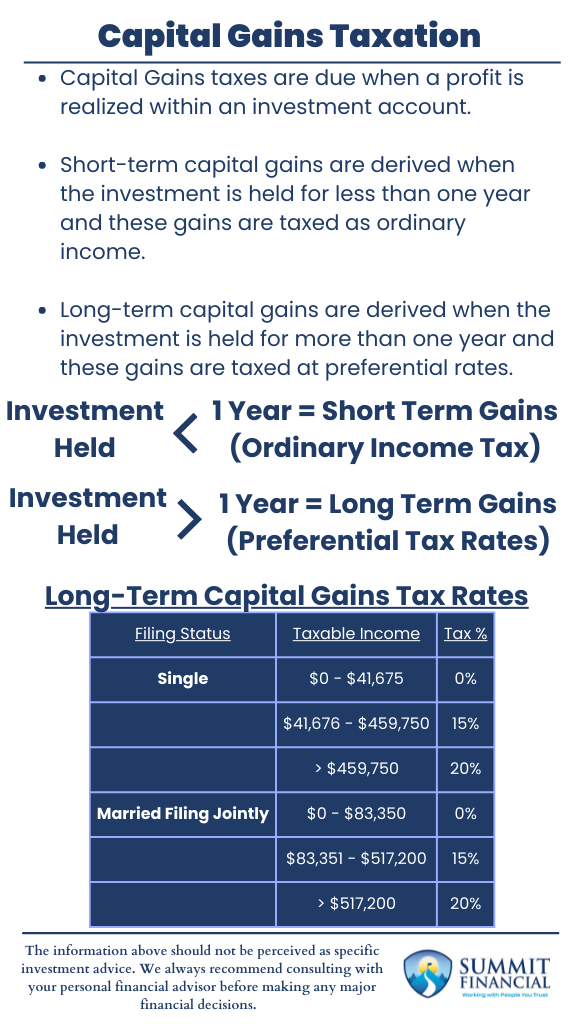
Summary: Capital Gains Tax
In summary, understanding how to calculate your capital gains tax rate is an essential step for most investors. There are a few key factors to consider:
- Capital Gains taxes are due when a profit is realized within an investment account.
- Short-term capital gains are derived when the investment is held for less than one year, and these gains are taxed as ordinary income.
- Long-term capital gains are derived when the investment is held for more than one year, and these gains are taxed at preferential rates.
Speak With a Trusted Advisor
If you have any questions about your investment portfolio, tax strategies, our 401(k) recommendation service, or other general questions, please give our office a call at (586) 226-2100. Please feel free to forward this commentary to a friend, family member, or co-worker. If you have had any changes to your income, job, family, health insurance, risk tolerance, or your overall financial situation, please give us a call so we can discuss it.
We hope you learned something today. If you have any feedback or suggestions, we would love to hear them.
Best Regards,
Zachary A. Bachner, CFP®
with contributions from Robert Wink, Kenneth Wink, and James Wink
Sources:

Zachary A. Bachner, CFP®
Advisor | Director of Financial Planning, Summit Financial Consulting, LLC
After graduating from Central Michigan University in 2017 with specialized degrees in Finance and Personal Financial Planning, Zachary “Zach” Bachner set himself apart by earning the CFP® designation and passing the Series 7, 63, 65 licensing exams early in his career. Zach gained valuable real-world experience with the team at Summit Financial Consulting, who treated him like family. Their guidance helped him refine his skills in practical, client-centered planning, where putting their needs first was non-negotiable. This focus on trust-building not only allowed him to cultivate strong relationships, but also allowed him to continue doing what he loves most: solving client problems through efficient financial planning strategies. Leveraging his experience, Zach now helps others navigate finances through clear, informative writing. His work has been published in major outlets like Yahoo Finance, MarketWatch, and Investment Business Daily, establishing him as a valued resource. By simplifying complex topics, Zach aims to empower everyday people to confidently pursue their financial goals
More about Zachary →