

Central Bank Digital Currencies and the Transformation of Modern Financial Systems

The global financial system is undergoing significant change as digitization accelerates and reliance on physical cash declines. In response, Central Bank Digital Currencies (CBDCs) have emerged as an important innovation in monetary policy and financial infrastructure.
CBDCs are digital forms of sovereign money issued by central banks, distinct from private cryptocurrencies and commercial bank deposits. Although still developing in many countries, they have the potential to reshape how money is issued, transferred, and regulated.
A CBDC represents legal tender backed by the issuing government and is designed to coexist with cash and traditional banking systems. Unlike decentralized digital assets, CBDCs operate within established regulatory frameworks and are centrally controlled.
They may be intended for retail use, accessible to the public, or wholesale use, limited to financial institutions. Central banks' interest in CBDCs reflects concerns over maintaining monetary sovereignty as private digital payment systems and stablecoins become more prominent.
Why Are Governments Developing Digital Currencies?
Countries may pursue CBDCs for different reasons. Advanced economies tend to focus on improving payment efficiency, system resilience, and competition within the financial sector. In contrast, emerging economies often emphasize financial inclusion and access to basic digital payment services.
International institutions such as the International Monetary Fund and the Bank for International Settlements have identified CBDCs as tools for modernizing payment systems while preserving the role of public money.
Across regions, a shared objective is evident: Ensuring that central banks remain relevant in an increasingly digital financial environment.
How Do CBDCs Change Monetary Policy and Banking?
CBDCs could alter how monetary policy is conducted. Traditional policy transmission relies heavily on commercial banks, whereas CBDCs may allow central banks to interact more directly with households and businesses.
For instance, digital currencies could enable faster distribution of stimulus payments or more precise policy interventions during economic downturns.
At the same time, CBDCs raise concerns about financial stability. If individuals transfer large portions of their funds from commercial banks to CBDCs, banks could face reduced deposit bases, limiting their capacity to lend.
To address this risk, many proposed CBDC models include safeguards such as holding limits or continued involvement of commercial banks as intermediaries.
What Are the Challenges and Risks of CBDCs?
CBDCs are often promoted for their potential to enhance financial inclusion by providing secure digital payment options to individuals without access to traditional banking. They may also improve payment efficiency by enabling faster settlement and reducing reliance on intermediaries, particularly in cross-border transactions.
However, significant concerns exist. Privacy may be compromised, as digital transactions generate data that could allow increased monitoring of individual behavior. Cybersecurity is another critical issue, as CBDC systems would constitute essential national infrastructure vulnerable to technical failures or cyberattacks. Additionally, insufficient international coordination could result in fragmented payment systems.
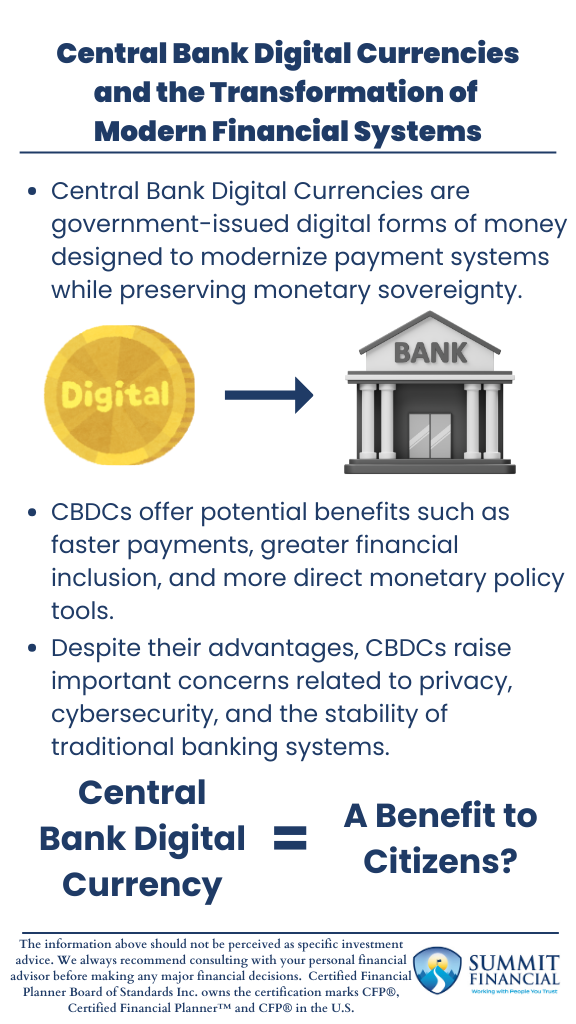
Central Bank Digital Currencies- Key Takeaways
- Central Bank Digital Currencies are government-issued digital forms of money designed to modernize payment systems while preserving monetary sovereignty.
- CBDCs offer potential benefits such as faster payments, greater financial inclusion, and more direct monetary policy tools.
- Despite their advantages, CBDCs raise important concerns related to privacy, cybersecurity, and the stability of traditional banking systems.
The Future of Central Bank Digital Currencies
Central Bank Digital Currencies represent a meaningful development in modern financial systems. While they offer potential benefits in efficiency, inclusion, and policy effectiveness, they also pose risks related to privacy, banking stability, and governance.
As a result, CBDCs should be viewed as complementary to existing financial structures rather than outright replacements. Their success will depend on careful design, public trust, and sustained international cooperation.
Questions About Your Portfolio?
If you have any questions about retirement, your individual investment portfolio, our 401(k)-recommendation service, or anything else in general, please contact our office a call at (586) 226-2100.
Please feel free to forward this commentary to a friend, family member, or co-worker. If you have had any changes to your income, job, family, health insurance, risk tolerance, or your overall financial situation, please give us a call so we can discuss it.
We hope you learned something today. If you have any feedback or suggestions, we would love to hear them.
Best Regards,
Daniel A. Ladzinski
with contributions by Robert L. Wink, Kenneth R. Wink, James D. Wink, Zachary A. Bachner, CFP® and James C. Baldwin
Daniel Ladzinski
A financial advisor at Summit Financial Consulting, Daniel graduated summa cum laude from Hillsdale College with a B.S. in Financial Management and Applied Mathematics in 2024. He has obtained several licenses, including the Series 7, Series 63, Series 65, Variable Life and Annuity Contracts, as well as Life, Health & Accident Insurance. Daniel has experience in several wealth management companies in the surrounding area. Each of these positions helped solidify his desire to serve clients and utilize his background in mathematics to pursue optimal financial plans. During his time in college, Daniel honed his analytical skills through active participation in the Hillsdale College Applied Mathematics Club. His strong interest in personal investing led him to develop specialized watchlists, alerts, and strategies, demonstrating his ability to create data-driven solutions. Among his many hobbies, Daniel is an avid multi-instrumentalist. He led the Hillsdale College Big Band on the saxophone, and he is currently delving into the music community of metro Detroit. He is also passionate about soccer, volleyball, disc golf, botany, numismatics, and, most importantly, his Catholic faith, family, and friends.
Sources
References:
- International Monetary Fund. (2023). Central bank digital currency: A new form of money. International Monetary Fund.
- Bank for International Settlements. (2021). Central bank digital currencies: Foundational principles and core features. BIS.
- European Central Bank. (2023). The digital euro: Policy goals and design considerations. European Central Bank