

Lump Sum vs Pension: Planning Life After Retirement

Pensions are a luxury that very few pre-retirees are still being offered today. Most employers are shifting away from pensions because these retirement benefits create a large strain on the company’s cash flow. However, if you have a lump sum vs. pension decision to make before retirement, this could be one of the toughest choices of your life.
Which option you select will surely have a huge impact on your retirement lifestyle and the probability of not outliving your retirement assets. This blog attempts to help explain the pros and cons of each option as well as the process we go through to determine the best route for our clients.
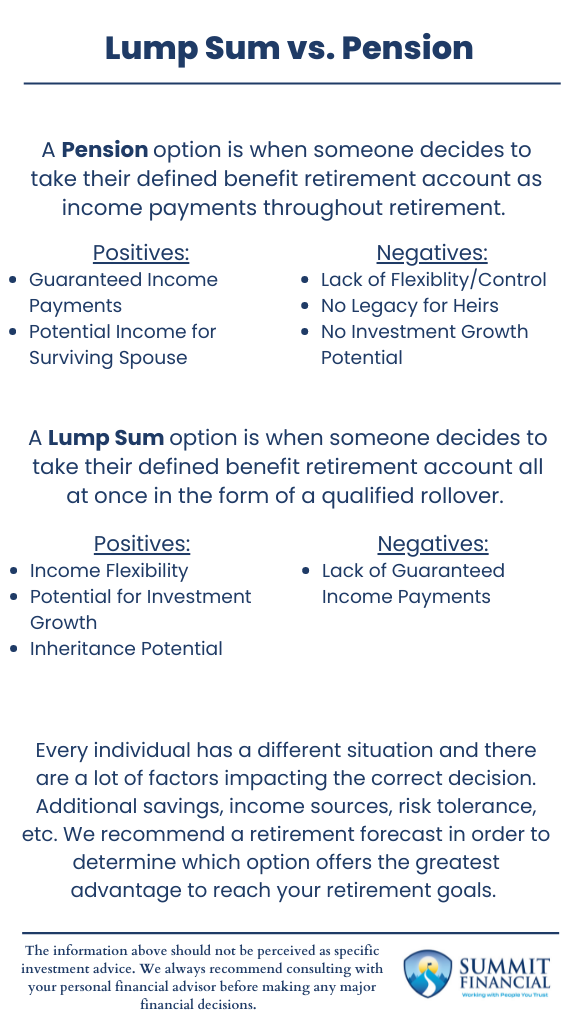
!Infographic illustrating the pros and cons of lump sum vs. pension options, including factors like income flexibility, risk tolerance, and inheritance potential.
Understanding the Lump Sum Option
Those who are offered a pension are usually offered a one-time lump sum option as well. This means that the defined benefit retirement account can be paid out all at once in the form of a qualified rollover. These rollovers are usually transferred to an IRA to avoid income taxation at the time of the lump sum transfer. Income taxes will be due when funds are withdrawn from the account throughout retirement.
Pros and Cons of Choosing a Lump Sum
The positives of the Lump Sum option include flexibility, outperformance potential, and inheritance potential. Flexibility refers to the concept that you are free to do as you please with the lump sum funds. You can spend, invest, gift, etc. the funds that are received from the lump sum. The assets are under your control and this allows you to be flexible with your retirement budget and withdrawals.
The lump sum option also may be a larger benefit over time if the assets are invested and earn a modest return. Investing the funds allows them to grow at a rate that may outpace inflation or any COLA rider on the pension. This provides the lump sum the potential to outgrow the collective pension payments. Lastly, a lump sum will allow you to pass on any remainder to your heirs. If inheritance is a strong goal of yours, then this may make the lump sum option more attractive.
The biggest downside to the lump sum option is the lack of recurring payments. Retirement income from these assets must be withdrawn from the retirement account, and these withdrawals are not guaranteed for life. If the account value is depleted, then it may become difficult to sustain the individual’s standard of living throughout retirement. This means the lump sum option is typically better suited for higher-risk individuals who may not need the guaranteed income stream of the pension.
Understanding the Pension Option
If you are offered a pension, you normally have a handful of options to choose from. You can have the benefits expire when you pass, you can have the benefits continue for a surviving spouse in various increments, and sometimes you can elect a period-certain benefit.
By having the benefits expire when you pass, this creates the largest income benefit during your lifetime. Obviously, if any portion of the benefits are elected to continue for a surviving spouse, then the benefits you will receive will be reduced.
The greater the benefit for the spouse, the greater the decrease for the insured individual while they are still alive. Period certain means the pension is guaranteed to be paid out over a set number of years (usually 10 years), and if you pass before the end of the timeframe, then the full benefits will be paid to a surviving spouse until the end of the period.
Pros and Cons of Choosing a Pension
The greatest advantage for the pension option is the reassurance of guaranteed income. Pensions provide an income stream throughout retirement that can be used to cover monthly expenses. Pensions are great for individuals who are lower risk and like the financial peace of mind of guaranteed payments.
Pensions are also ideal for those who have consistent monthly budgets and do not expect to need random sums of money to pay for sporadic expenses.
The downside to the pension is the lack of freedom that comes with it. Unlike the lump sum, you do not control the assets that are used to fund the pension. This means that you do not invest the account balance nor is there any potential to leave an inheritance for your heirs.
You can invest and save any excess pension payments, but that is the most you can do for growth potential. Your surviving spouse may receive a pension benefit if you elect the spousal option at retirement, but there is no benefit for your children or other heirs once you pass away. Unless you have other assets set aside, a pension is not going to provide an inheritance for you to pass on.
Conclusion: Deciding Which Option is Right for You
Of course, every individual’s situation is different, so we cannot use a blanket strategy when making recommendations for these types of decisions. Factors we typically consider are the client’s retirement lifestyle preference and budget, risk tolerance, inheritance goals, whether additional retirement savings are available, and more.
Also, every lump sum and pension option scenario is different. We normally see the annual pension payments around 3-5% of the total lump sum amount, but that is not always true. Sometimes, individuals are offered above a 5% payout, and sometimes, they are offered below a 3% payout.
We take all these factors into consideration when analyzing our client’s potential options. Most importantly, we use a program called Retire Up to help us illustrate the impact the options available. To do this, we input all the retirement info we have for the clients into our system, and the result is a forecast of the retirement outcome and likelihood of success.
By keeping all variables the same, except for the pension and lump sum benefits, we can isolate these choices and help determine mathematically which route makes the most sense. However, sometimes, our clients side with their personal preferences on the option instead of choosing the best option mathematically. This is totally fine as long as our retirement illustration is still successful.
Speak With a Trusted Advisor
If you have any questions about your investment portfolio, tax strategies, our 401(k) recommendation service, or other general questions, please give our office a call at (586) 226-2100. Please feel free to forward this commentary to a friend, family member, or co-worker. If you have had any changes to your income, job, family, health insurance, risk tolerance, or your overall financial situation, please give us a call so we can discuss it.
We hope you learned something today. If you have any feedback or suggestions, we would love to hear them.
Best Regards,
Zachary A. Bachner, CFP®
with contributions from Robert Wink, Kenneth Wink, and James Wink
If you found our article helpful, consider reading our other recent posts on Bull vs. Bear Market, Record Inflation, and Fiduciary vs. Financial Advisor.
Zach Bachner
After graduating from Central Michigan University in 2017 with specialized degrees in Finance and Personal Financial Planning, Zachary “Zach” Bachner set himself apart by earning the CFP® designation and passing the Series 7, 63, 65 licensing exams early in his career. Zach gained valuable real-world experience with the team at Summit Financial Consulting, who treated him like family. Their guidance helped him refine his skills in practical, client-centered planning, where putting their needs first was non-negotiable. This focus on trust-building not only allowed him to cultivate strong relationships, but also allowed him to continue doing what he loves most: solving client problems through efficient financial planning strategies. Leveraging his experience, Zach now helps others navigate finances through clear, informative writing. His work has been published in major outlets like Yahoo Finance, MarketWatch, and Investment Business Daily, establishing him as a valued resource. By simplifying complex topics, Zach aims to empower everyday people to confidently pursue their financial goals