

Will Rare Earth Material Prices Keep Rising in 2026?

As 2026 unfolds, rare earth materials have become increasingly central to the global economy. These elements are critical for technologies such as electric vehicles, wind turbines, and advanced defense systems.
They are no longer obscure inputs but, instead, strategic resources. Rising demand, combined with concentrated supply chains dominated by a few countries, has led to significant price increases and heightened geopolitical attention.
Despite this strong upward momentum, the current trajectory of rare earth prices remains uncertain.
While structural demand appears robust, a combination of economic, technological, and demographic factors may prevent prices from rising indefinitely. Understanding these dynamics is essential for policymakers, investors, and industries reliant on these materials.
What Are Rare Earth Materials and Why Do They Matter?
Demand for rare earth materials continues to grow due to several key trends. The global transition toward clean energy is a major driver, as rare earth magnets are essential components in both electric vehicles and wind energy systems.
In addition, rising geopolitical tensions have increased defense spending, further boosting demand for advanced materials used in military technologies.
Technological innovation also plays a role. From consumer electronics to robotics and semiconductor manufacturing, rare earth elements are embedded in a wide range of high-growth industries.
As these sectors expand, demand for these materials is expected to remain strong, reinforcing their strategic importance.
What Do Recent Price Trends Tell Us About the Rare Earth Market?
In recent years, rare earth prices have experienced significant volatility but an overall upward trend. Supply chain disruptions, export controls, and geopolitical tensions have contributed to price spikes, particularly for key elements used in high-performance magnets.
At the same time, the market has shown signs of instability. Prices often react sharply to policy changes or supply concerns, reflecting the relatively concentrated nature of production and processing.
While current conditions support elevated prices, this volatility highlights the influence of external factors beyond simple supply and demand.
Why Might Rare Earth Prices Not Continue Rising Indefinitely?
Although the long-term outlook for rare earth materials remains positive, several factors could limit future price growth.
- Market Cycles: Commodity markets are inherently cyclical. Periods of rapid price increases are often followed by corrections as markets adjust and speculative activity declines. This suggests that even in a strong market, temporary downturns are likely.
- Emerging Supply: New supply is gradually emerging. Governments and private companies are investing heavily in rare earth mining and processing outside traditional strongholds. While these projects take time to develop, increased supply over the long term could ease upward pressure on prices.
- Technological Adaptation: Technological adaptation may reduce dependence on rare earths. As prices rise, companies have strong incentives to improve efficiency, develop alternative materials, and expand recycling efforts. These adjustments can moderate demand growth and limit extreme price increases.
- Macroeconomic and Demographic Factors: Broader macroeconomic and demographic factors may also play a role. As aging populations—particularly baby boomers—shift toward retirement, investment patterns may change. Capital could move away from higher-risk or speculative assets, including certain commodity markets, and toward more stable income-generating investments. In addition, slower economic growth associated with aging populations may reduce the pace of industrial expansion, indirectly dampening demand for raw materials.
While these demographic effects are less direct than supply and demand fundamentals, they may still contribute to a more moderate and less explosive price environment over time.
What Does the Rare Earth Market Outlook Mean for Investors?
Rare earth materials are likely to remain a cornerstone of the modern global economy, supported by strong demand from clean energy, defense, and advanced technology sectors. This structural importance suggests that prices will remain elevated relative to historical levels.
However, it is unlikely that prices will increase continuously without interruption. Market cycles, expanding supply, technological innovation, and broader economic forces—including demographic shifts—are all likely to influence future price trends.
Ultimately, the rare earth market reflects a balance between long-term strategic demand and short-term economic realities.
While the outlook remains positive, a more nuanced expectation, characterized by growth tempered by volatility and periodic corrections, provides a more realistic view of what lies ahead.
Key Takeaways
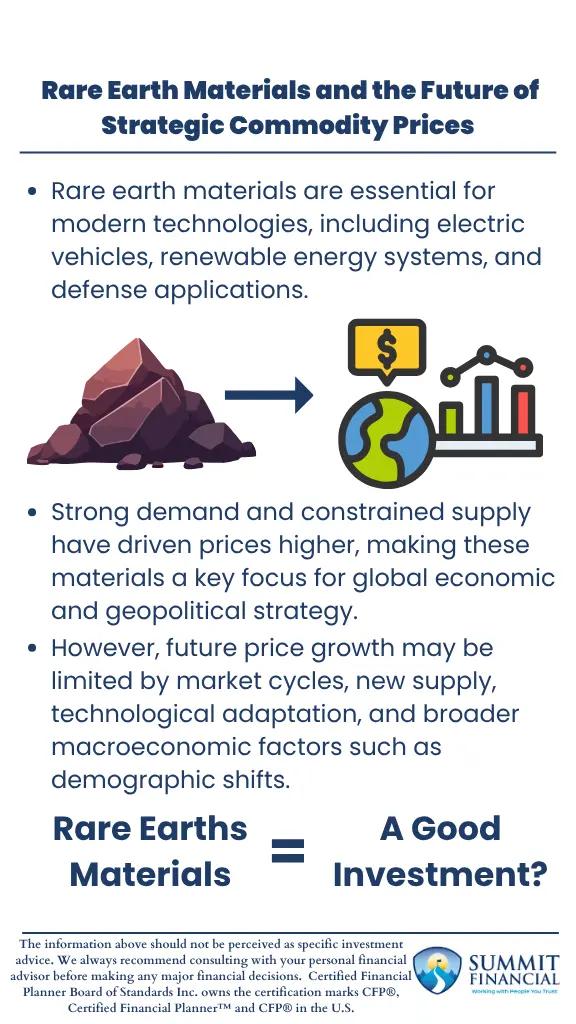
- Rare earth materials are essential for modern technologies, including electric vehicles, renewable energy systems, and defense applications.
- Strong demand and constrained supply have driven prices higher, making these materials a key focus for global economic and geopolitical strategy.
- However, future price growth may be limited by market cycles, new supply, technological adaptation, and broader macroeconomic factors such as demographic shifts.
Questions About Your Investment Strategy in Commodity Markets?
If you have any questions about your investment portfolio, retirement planning, tax strategies, our 401(k) recommendation service, or other general questions, please give our office a call at (586) 226-2100.
Please feel free to suggest this blog post to a friend, family member, or co-worker. If you have had any changes to your income, job, family, health insurance, risk tolerance, or your overall financial situation, please give us a call so we can discuss it.
We hope you learned something today. If you have any feedback or suggestions, we would love to hear them.
Best Regards,
Daniel A. Ladzinski, CRPC®, AWMA®
with contributions by Robert L. Wink, Kenneth R. Wink, James D. Wink, Zachary A. Bachner, CFP®, and James C. Baldwin.
Daniel Ladzinski
A financial advisor at Summit Financial Consulting, Daniel graduated summa cum laude from Hillsdale College with a B.S. in Financial Management and Applied Mathematics in 2024. He has obtained several licenses, including the Series 7, Series 63, Series 65, Variable Life and Annuity Contracts, as well as Life, Health & Accident Insurance. Daniel has experience in several wealth management companies in the surrounding area. Each of these positions helped solidify his desire to serve clients and utilize his background in mathematics to pursue optimal financial plans. During his time in college, Daniel honed his analytical skills through active participation in the Hillsdale College Applied Mathematics Club. His strong interest in personal investing led him to develop specialized watchlists, alerts, and strategies, demonstrating his ability to create data-driven solutions. Among his many hobbies, Daniel is an avid multi-instrumentalist. He led the Hillsdale College Big Band on the saxophone, and he is currently delving into the music community of metro Detroit. He is also passionate about soccer, volleyball, disc golf, botany, numismatics, and, most importantly, his Catholic faith, family, and friends.
Sources
- Global X ETFs - Rare Earth and Critical Materials ETF (EART)
- International Energy Agency (IEA) - Critical Minerals Market Review 2024
- McKinsey & Company - The Raw-Materials Challenge
- U.S. Geological Survey - Mineral Commodity Summaries: Rare Earths
- VanEck - Rare Earth and Strategic Metals ETF (REMX)
- S&P Global Market Intelligence - Rare Earth Supply Chain and Pricing Outlook
- Reuters - Global Rare Earth Supply Chains Face Bottlenecks
- World Bank - Minerals for Climate Action
- International Energy Agency (IEA) - Role of Critical Minerals in Clean Energy Transitions