

Unnecessary Costs: 5 Common Budget Drains to Watch For

Budgeting is normally the first step we recommend for our clients towards creating a strong financial foundation. We believe it is important to review your budget periodically to ensure all expenses are being accounted for and so that adjustments may be implemented if needed.
Things such as credit card interest, unused streaming services, storage units, annual phone upgrades, gambling, and other unnecessary costs are items we commonly come across with clients.
Why Budgeting Matters for Wealth Building
Especially for those who are just beginning their wealth building journey, budgeting is normally the first step for our clients towards helping to create a strong financial foundation. Budgeting is important because in order to build wealth efficiently, we believe you should be trying to spend less and save/invest more on a monthly basis.
You can review our previous blog post about budgeting at what is budgeting.
How to Review Your Budget Periodically
This is why we recommend periodically reviewing your budget. Our budget worksheet provides clients with a structured way to outline and track spending across a wide range of categories. There are also "Other" or blank fields that can be customized if needed.
Once the initial budget outline is created, we believe it is important to review this periodically and compare against the actual spending to ensure the inputs are accurate. Any variance between the outlined budget and the incurred expenses may indicate that adjustments are needed, whether this means revising your spending expectations or identifying areas where expenses can be reduced.
Many credit card providers offer spending summaries and categorized reports; however, we find these classifications are not always accurate. Reviewing expenses individually encourages a more intentional process and helps clients recognize the full scope of their spending habits.
Review frequency:
- For clients who want to maintain a more precise budget or closely monitor their spending, we recommend completing this review monthly.
- Others may find a quarterly review sufficient.
- At a minimum, we recommend reviewing your budget and actual expenses at least once per year to ensure your financial plan continues to reflect your current circumstances and goals.
Common Unnecessary Expenses to Eliminate
There are some common items that we come across with clients that we believe are usually unnecessary costs. Now, there are times when these expenses may be unavoidable, but we also believe these items should be kept to a minimum, and preferably nonexistent if possible.
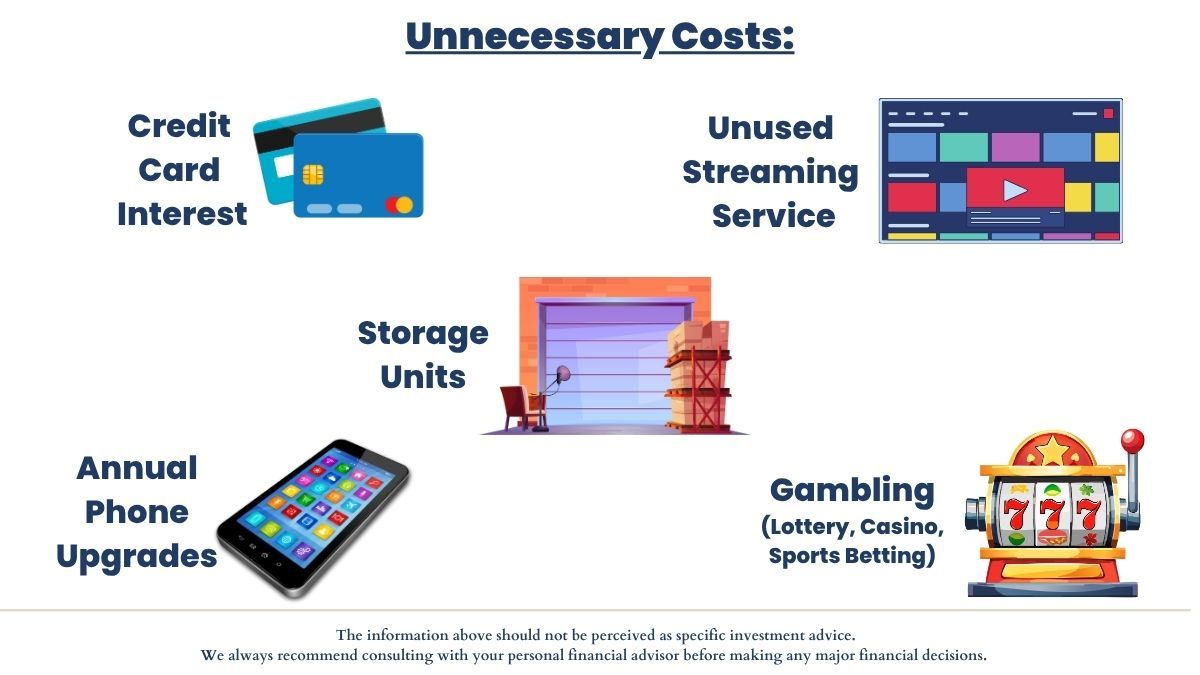
Credit Card Interest
Many clients use credit cards to earn rewards or points on their purchases, which can provide benefits such as cashback, reduced travel costs, or other incentives. We are comfortable with this type of usage as long as the balance is paid in full each month. We also recognize that credit cards can sometimes be a necessary tool for managing unexpected expenses or short-term cash flow needs.
However, carrying a balance from month to month can become costly due to the high interest rates typically associated with credit card debt.
Whenever possible, credit card balances should be paid off monthly to avoid unnecessary interest charges. If balances are consistently carried forward, it may be a sign that spending needs to be reevaluated, as interest charges can significantly increase the overall cost of purchases over time.
Unused Streaming Services
There are so many streaming services available these days and we see these expense items increasing more and more while cable bills are becoming less common. The issue is that some people feel the need to subscribe to every streaming service – Netflix, Disney +, Amazon Video, Apple TV, HBO, Paramount +, etc.
We have seen that clients rarely use all of these services in the same month, so we usually suggest cancelling these subscriptions if they are not used frequently. You can always subscribe again later to watch something specific if you feel strongly about it. Subscription services may seem small month-to-month, but they can certainly build up to big expenses over time if not kept in check.
Storage Units
There are circumstances where renting a storage unit can be a practical and temporary solution, such as during a move, home renovation, downsizing, job transition, or other major life changes. However, we encourage clients to periodically evaluate whether a storage unit is serving a specific purpose or has simply become a long-term expense for storing items that are rarely used.
Storage units can create an ongoing monthly cost that is easy to overlook because the expense often feels separate from everyday household spending. Over time, these costs can add up significantly without providing a meaningful benefit.
Additionally, having additional storage space can sometimes make it easier to accumulate more belongings rather than evaluating what items are truly necessary or valuable.
We recommend considering whether the items being stored are worth the ongoing cost of storage, and whether there may be opportunities to declutter, donate, sell, or better organize existing belongings. In many cases, reducing unnecessary storage expenses can free up money in the budget for goals that provide greater long-term value.
Annual Phone Upgrades
Technology continues to advance quickly, and there are certainly situations where replacing a phone is necessary. However, upgrading every year can become an expensive habit that may not provide meaningful value compared to the cost. Many newer smartphones can cost $1,000 or more, making frequent upgrades a significant discretionary expense over time.
We encourage clients to consider maximizing the useful life of their current device and replacing it when there is a true need, such as declining performance, insufficient storage, software limitations, or physical damage. For many individuals, keeping a phone for 3–5 years can provide a better balance between having reliable technology and avoiding unnecessary spending.
Additionally, many cellular providers offer trade-in programs and promotional incentives that can reduce the cost of upgrading. These programs often work by applying monthly credits toward the cost of a new device, which can make the phone appear "free" or significantly discounted.
While these offers can be valuable, it is important to understand the terms, including any requirements to remain with the provider for a specific period of time. Taking advantage of these programs strategically can allow you to replace your device when needed while minimizing the impact on your overall budget.
Gambling
Gambling expenses can take many forms, including lottery tickets, casino visits, sports betting, and other forms of wagering. While occasional entertainment spending may fit within a well-managed budget, it is important to recognize that gambling should be approached as entertainment rather than a strategy for building wealth.
The challenge with gambling is that small, frequent purchases can add up over time. A few dollars spent on lottery tickets each week or regular sports wagers may not seem significant individually, but these expenses can become substantial when viewed annually.
We encourage clients who choose to participate in gambling activities to account for these expenses within their budget and establish reasonable limits.
Although some individuals experience occasional winnings, the odds generally favor the gambling operator over the long term. Money directed toward frequent gambling could otherwise be used toward goals such as saving, investing, paying down debt, or other priorities that support long-term financial success.
Additionally, because gambling can become addictive for some individuals, maintaining awareness of spending patterns and setting boundaries early can be an important part of responsible financial management.
Unnecessary Costs- Key Takeaways
- Budgeting is the foundation for wealth building—it helps you identify overspending and increase monthly cash flow for saving and investing.
- Review your budget periodically (monthly for precision tracking, quarterly minimum, at least annually)—compare actual spending to budgeted amounts and adjust as needed.
- Credit card interest, unused subscriptions, storage units, unnecessary phone upgrades, and gambling are common unnecessary expenses—eliminate or minimize these to free up budget capacity.
- Small recurring expenses (streaming services, storage, phone upgrades) add up significantly over time—regularly assess whether these items provide meaningful value.
- Credit cards can be valuable for rewards if paid in full monthly, but carrying balances due to high interest rates undermines wealth building—prioritize paying off balances monthly.
- Gambling should be treated as entertainment with strict limits, not as a wealth-building strategy—small frequent bets accumulate to substantial annual expenses.
Getting Help With Your Budget
If you have any questions about your investment portfolio, retirement planning, tax strategies, our 401(k) recommendation service, or other general questions, please give our office a call at (586) 226-2100.
Please feel free to suggest this blog post to a friend, family member, or co-worker. If you have had any changes to your income, job, family, health insurance, risk tolerance, or your overall financial situation, please give us a call so we can discuss it.
We hope you learned something today. If you have any feedback or suggestions, we would love to hear them.
Best Regards,
Zachary A. Bachner, CFP®
with contributions from Robert L. Wink, Kenneth R. Wink, and James D. Wink.
Zach Bachner
After graduating from Central Michigan University in 2017 with specialized degrees in Finance and Personal Financial Planning, Zachary “Zach” Bachner set himself apart by earning the CFP® designation and passing the Series 7, 63, 65 licensing exams early in his career. Zach gained valuable real-world experience with the team at Summit Financial Consulting, who treated him like family. Their guidance helped him refine his skills in practical, client-centered planning, where putting their needs first was non-negotiable. This focus on trust-building not only allowed him to cultivate strong relationships, but also allowed him to continue doing what he loves most: solving client problems through efficient financial planning strategies. Leveraging his experience, Zach now helps others navigate finances through clear, informative writing. His work has been published in major outlets like Yahoo Finance, MarketWatch, and Investment Business Daily, establishing him as a valued resource. By simplifying complex topics, Zach aims to empower everyday people to confidently pursue their financial goals